
Blustery Pusan

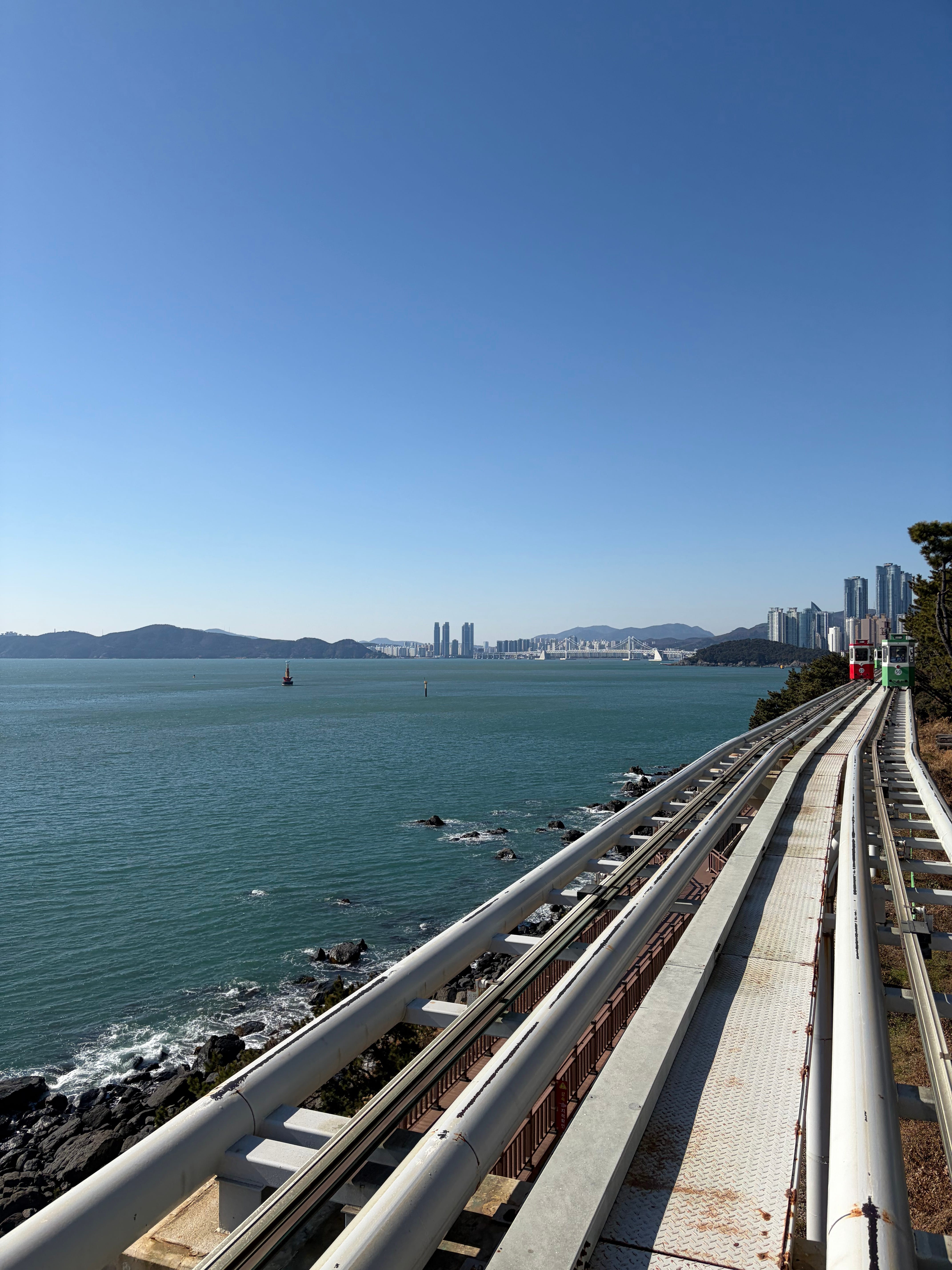
This week saw the start of two months of pretty extensive travelling with four nights in Busan/Pusan, South Korea. I spell it both ways because I honestly can’t work out which is more correct. English maps use B, Japanese use P, and when Koreans pronounce it, it sounds more like P to me but then I don’t speak Korean. One of my students is from here and when I said “I’m going to Busan” she said “Where? Oh, Pusan” so I’m going with that. Mainly I err towards using P since it then sounds like I’m talking about Winnie-the-Pooh in Japanese (Pooh-san). I could also be talking about the Chinese president.
I’ve been to South Korea a few times (five I think, I’ve lost count and Minori and I spent most of the flight arguing about how many times she’s been) but never to Pusan. It’s on the south coast, the city nearest Japan, just across the water. In Japan it’s mainly known for its gorgeous beaches so we decided to come in the middle of January when temperatures drop well below zero. People told me that Pusan is like Korea’s Osaka, with Seoul as Tokyo, but everyone here seems really nice so the analogy seems false.
Three full days of sightseeing and hiking, some utterly delicious food, Minori sneaking more and more souvenirs into my suitcase, and we’re just about ready to head home. The highlight was probably hiking through the mountains around Pusan, setting off before dawn with the temperature at a bracing -8c, though it eventually climbed to a balmy -6c. The hills are filled with historical relics, mostly from the Japanese invasion of the 16th century, including the extensive fortifications and watchtowers (one of which was still manned, scaring the crap out of us. We assume he was fire watching and not on the lookout for Japanese invaders). That made for a nice bookend since a few years back I visited Nagoya Castle (not that one) in Fukuoka, which was built to ward off a revenge Korean invasion. The narrow straits separating Japan and Korea reminded me of the channel separating England and France, two very similar cultures who should be much more friendly than they are. From the top we could see the island of Tsushima, which the Koreans call Daemado. It is historically disputed territory, currently under Japanese control (and the site of many fly-bys and training exercises by the Japanese self-defence forces) but only 50km from the Korean coast. When viewed from this proximity, it’s hard not to think the Koreans have a point.
I’m back home for the weekend, and then off again next week by myself for a writing-related research trip. After that there’s domestic trips to Kyushu and Kyoto, followed by my first trip back to the homeland in three years. In between I need to prepare for two conferences, finish a paper, finish an article, and begin work on the introduction of a translation I’ve been co-authoring. It’s a busy start to the year, exactly how I like it.


